Contact Lenses Full Guide — Categories, Standard Production & Targeted User Recommendations
News 2026-03-24
Data Sources: China Chamber of Commerce for Import & Export of Medicines & Health Products, China Science Communication, Industry Production Standards White Paper
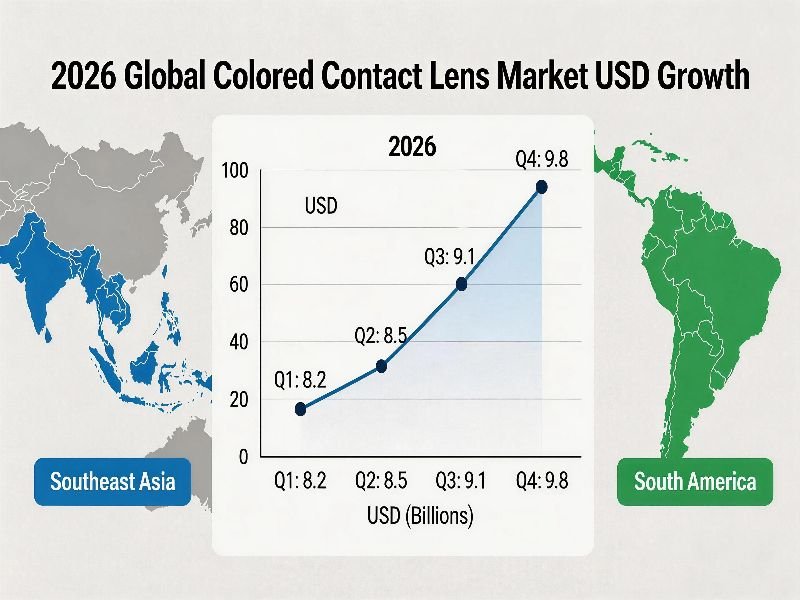
As a medical optical device for vision correction and beauty decoration, contact lenses have detailed categories and strict production processes. Lenses of different materials, replacement cycles and functions are suitable for distinct groups. At present, the global contact lens market is dominated by soft contact lenses (over 85% market share), with colored contact lenses leading the growth trend. This guide comprehensively interprets the contact lens product system from three dimensions: full category division, standardized production and group-oriented adaptation, helping precise purchase and foreign trade procurement.
1. Full Contact Lens Category Division (Global Standard)
1.1 Classification by Core Material (Key Dimension)
- Soft Hydrogel Lenses: Traditional mainstream material with 38%-60% water content, soft and fit cornea, high wearing comfort, short adaptation period, affordable price, suitable for daily short-term wear by low myopia groups.
- Silicone Hydrogel Lenses: Upgraded high-end material, 6x higher oxygen permeability than ordinary hydrogel (DK/t > 175×10-9), low water content, high oxygen permeability, less dryness for long-term wear, accounting for over 70% of the global market, widely used in high-end export lenses.
- Rigid Gas Permeable Lenses (RGP): Made of fluorosilicone acrylate, hard texture, stable optical performance, excellent for high astigmatism and keratoconus correction, 1-2 years service life, suitable for professional vision correction groups (1-2 weeks adaptation period needed).
- Orthokeratology Lenses (OK Lenses): Special rigid lenses worn at night to temporarily restore clear vision during the day, mainly for juvenile myopia control, requiring professional medical institution fitting.
1.2 Classification by Replacement Cycle
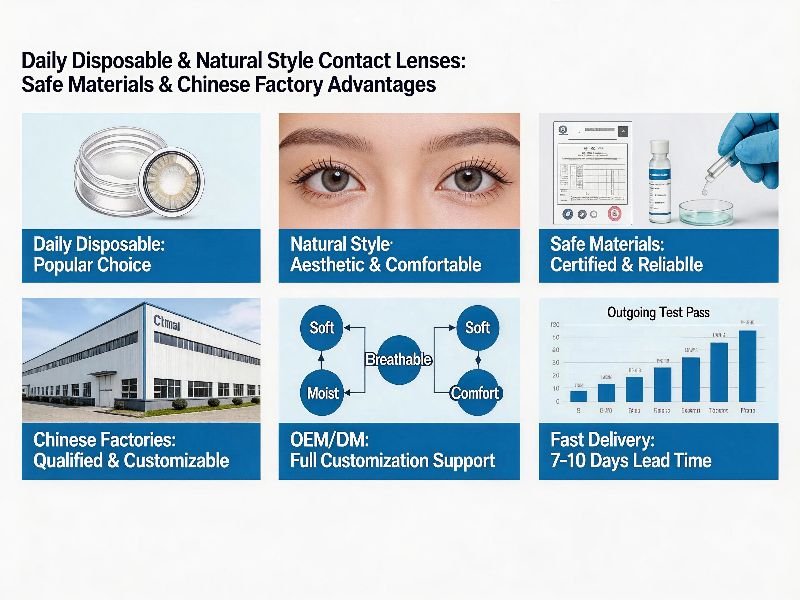
- Daily Disposable: Discard after single use, no care needed, maximum hygiene, reduces bacterial growth risk, accounting for over 45% market share (fastest growing category), ideal for occasional wearers, students and business travelers.
- Short-term Disposable (2-week/Monthly/Quarterly): Regular replacement, daily care needed, cost-effective, suitable for office workers and students with regular wearing habits.
- Long-term Disposable (Half-year/Yearly): Long service life, good lens formability, suitable for high myopia groups with limited budget, requiring strict cleaning and care.
1.3 Classification by Function
- Clear Vision Correction Lenses: Basic style for myopia, hyperopia and astigmatism correction without decorative effect, suitable for daily vision correction needs.
- Colored Contact Lenses (Cosmetic Lenses): Combine vision correction and beauty functions, 4 times the market size of clear lenses, with natural, mixed-race and daily styles, suitable for beauty lovers and fashion groups.
- Special Function Lenses: Include astigmatism custom lenses, multifocal presbyopic lenses, color blindness correction lenses and medical bandage lenses for special vision problems.
2. Medical-Grade Standard Contact Lens Production Process
All export-oriented Chinese contact lens manufacturers strictly follow ISO13485 Medical Device Quality System, GMP sterile standards, and international certifications including FDA and CE. The entire production is completed in Class 10000 clean rooms to avoid contamination, ensuring every lens meets global medical safety requirements, which is the core quality advantage of Chinese-made contact lenses for worldwide export.
Export-oriented Chinese contact lens factories strictly follow ISO13485 Medical Device Quality Management System and GMP sterile standards, with whole-process production in Class 10000 clean rooms. Four core processes are adopted, with molding and spin casting as mainstream methods for mass production and stable quality.
2.1 Core Production Technologies
- Molding Method (Mainstream Mass Production): Liquid polymer monomer placed in precision molds, cured by UV and heat, suitable for daily and short-term disposable lenses, high efficiency, uniform thickness, product qualification rate over 99%, core process for colored contact lenses.
- Spin Casting Method: Liquid raw material injected into high-speed rotating molds, formed by centrifugal force, suitable for soft hydrogel lenses, smooth surface, comfortable wear, ideal for large-scale standardized production.
- Lathe Cutting Method: Solid raw material precisely cut and polished by CNC lathe, high processing accuracy, suitable for RGP and custom astigmatism lenses, supports personalized customization (higher production cost).
2.2 Complete Production Procedure
Raw material proportioning → injection molding in Class 10000 clean room → UV/heat curing → fine polishing → hydration expansion → automatic quality inspection (thickness, curvature, oxygen permeability, degree accuracy) → sterile cleaning → packaging sterilization → vacuum sealing → finished product warehousing. No direct manual contact with lenses, each batch passes strict tests to meet FDA, CE and international medical standards.
3. Targeted Contact Lens Guide for Different Groups
Eye conditions, wearing time and usage needs vary widely among different groups. Choosing the right material, cycle and function is crucial for wearing comfort and eye health. Below are professional recommendations for six core user groups, covering daily and special usage scenarios.
3.1 Teenagers & Students
Prioritize daily disposable clear lenses or silicone hydrogel short-term lenses, limit daily wear to 8 hours. OK lenses are optional for myopia control under professional guidance. Colored contact lenses are not recommended without adult supervision and professional fitting.
3.2 Office Workers & Daily Commuters
Choose silicone hydrogel monthly/2-week disposable clear lenses, high oxygen permeability relieves eye dryness from long-term screen use. Natural colored contact lenses are suitable for occasional beauty needs, with standard diameter (14.0-14.2mm) to ensure comfort.
3.3 High Myopia/ Astigmatism Groups (Myopia > 600°, Astigmatism > 200°)
Opt for RGP lenses or custom silicone hydrogel astigmatism lenses, better optical stability and correction effect. Avoid ultra-thin lenses, choose long-term disposable or custom styles for stable wearing and clear vision, with regular eye check-ups.
3.4 Beauty Lovers & Fashion Groups
Focus on high oxygen permeability colored contact lenses (daily/2-week disposable), prioritize silicone hydrogel material, avoid low-quality non-medical pigment lenses. Select standard diameter styles, daily disposable is ideal for frequent color changes.
3.5 Middle-aged & Presbyopia Groups
Suitable for multifocal soft contact lenses or bifocal lenses correcting both myopia and presbyopia. Choose low water content, high oxygen permeability material, limit daily wear to 6 hours, prioritize short-term disposable lenses to reduce infection risk.
3.6 Occasional Wearers & Travelers
Top choice: daily disposable lenses (clear or colored), no need for care solution or case, portable and hygienic, avoids eye inflammation caused by poor cleaning during travel, safe and convenient for temporary wear.